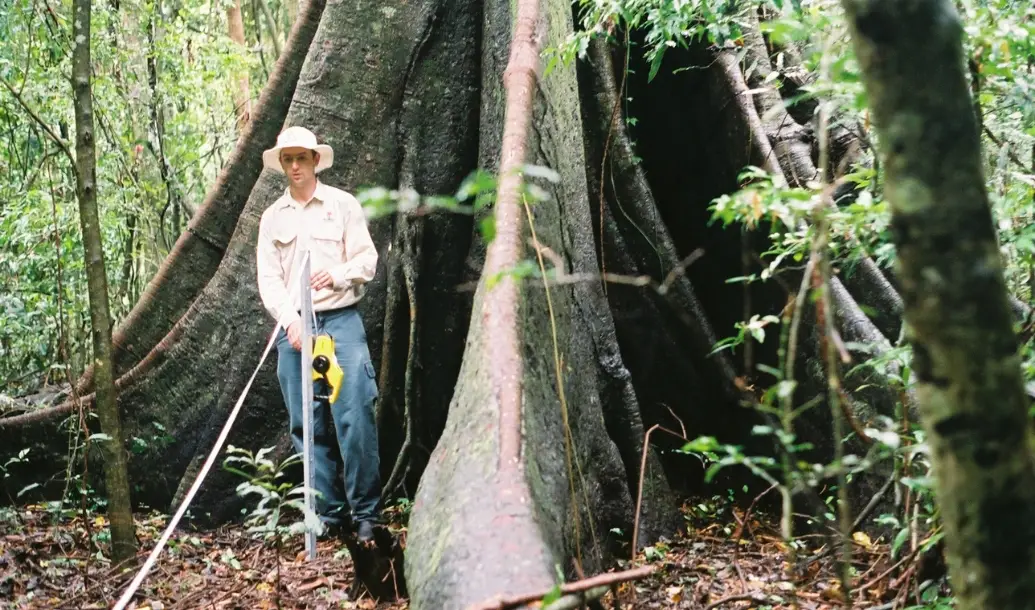
After decades spent in regeneration in the Northern Rivers, there’s little about the Big Scrub that Dan Cox is yet to experience.
From early work in the deepest parts of the rainforest, removing football field-sized patches of lantana in Wompoo Gorge, Wanganui, Minyon and the Big Scrub Flora Reserve, to working in Alcheringa and other privately owned remnants, Dan has been directly involved in restoring so much of what was left of the Big Scrub.
Inspired by a childhood spent exploring the sandstone escarpments of Gosford with his grandfather, and an upbringing spent wandering nature reserves near Goonellabah, Dan felt the call of regen early on, leading him to pursue a science degree at Southern Cross University before undertaking an internship with Envite Environment. These experiences set him firmly on the path of ecological restoration. He had found his calling.
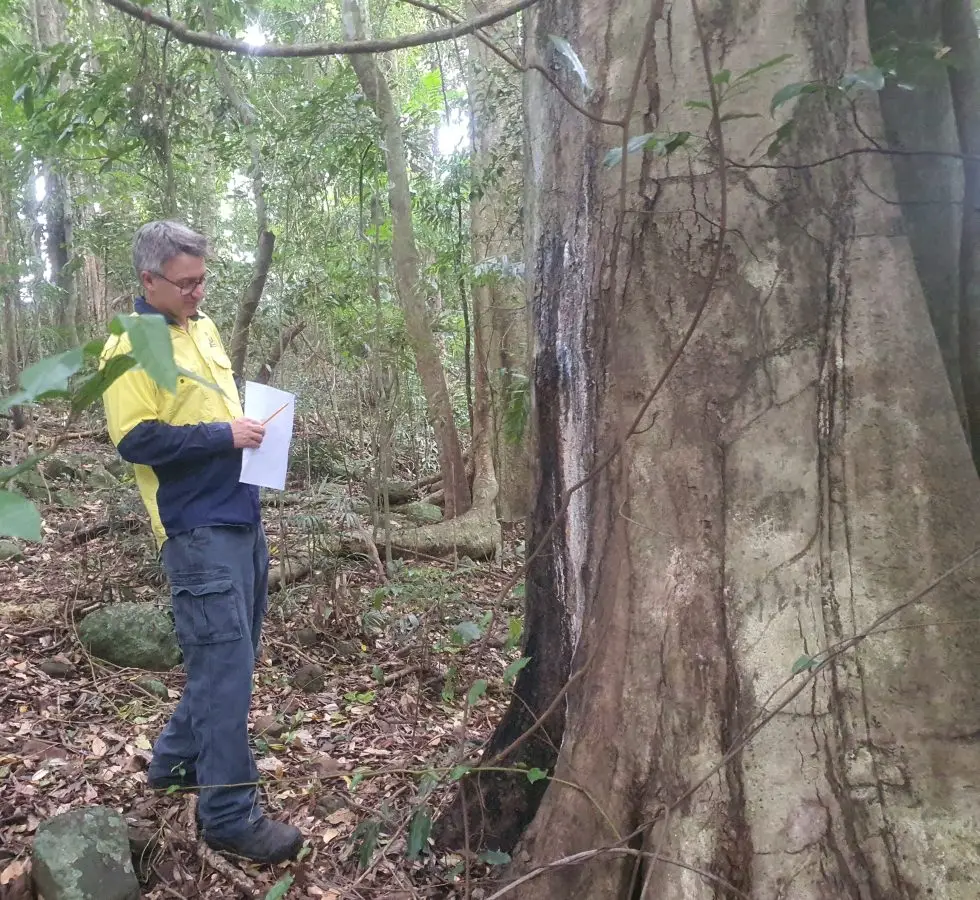
After formative years with Envite working alongside notable restoration ecologists, securing funding and working across various teams, Dan was soon leading bush regeneration teams of his own. Dan’s teams played a direct role in rescuing remnants, like Victoria Park and Davis Scrub Nature Reserves, from severe weed infestations.
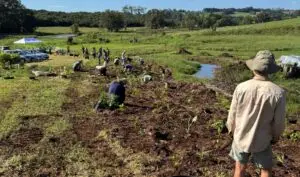
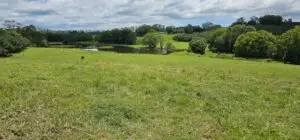
Restoration work is slow but deeply rewarding. When Dan first arrived at Victoria Park, the north-east corner was overrun with mature ochna. The south-east corner was an open tangle of lantana, camphor laurel and crofton weed. With funding from Big Scrub Rainforest Conservancy and the 20 Million Trees Program, along with labour from Green Army, Dan’s team revegetated the entire south-east corner of the remnant. Today, what was once an open-canopy mess has transformed into a diverse, closed-canopy rainforest.
Davis Scrub posed its own challenges. Its southern edge was dominated by blue billy goat weed and setaria, with little natural regeneration. The northern edge was thick with camphor laurel, lantana, and ochna, while the western edge was strangled by climbing asparagus vine. Its weed infestations are now largely under control, enabling the rainforest to naturally regenerate.
Alcheringa, a privately owned Big Scrub remnant, was one of Dan’s first projects where little previous primary restoration had been done. The dense thickets of privet and camphor laurel were so impenetrable that you couldn’t see five meters ahead. Today, it has reached the maintenance phase, with only seedling exotics appearing sporadically.
Dan’s work in Wompoo Gorge (now a part of Nightcap National Park) involved controlling football field-sized patches of impenetrable lantana with the splatter method. The use of a high concentration low volume method allowed teams to cover extensive areas in a fraction of the time taken in the past. Envite has since utilised this method to undertake primary restoration of thousands of hectares of lantana – most notably in Nightcap National Park at Wanganui Gorge, Minyon Falls and Big Scrub Flora Reserve.
Beyond the satisfaction of seeing degraded ecosystems recover, Dan has always been driven to improve restoration techniques – finding more efficient, effective ways to tackle invasive species. Over the years, these are some of refinements made to Envite’s methods:
- Cat’s Claw Creeper Trials: A 1:100 glyphosate dilution was as effective as 1:50, enabling less chemical use, and switching from the traditional cut, scrape, and paint method to cutting and later spraying regrowth significantly improves efficiency.
- Lantana Control: Early on, lantana was removed manually or sprayed. Later, at Wompoo Gorge, a splatter method was adopted – a low-volume, high-concentration herbicide approach. This technique has since been used to restore thousands of hectares, including Wanganui Gorge, Minyon Falls and Big Scrub Flora Reserve.
- Adaptive Weed Management: At Davis Scrub, repeated glyphosate applications were merely opening space for new weeds. By using a broadleaf-selective herbicide (metsulfuron-methyl) for blue billy goat weed while applying glyphosate only to grasses and woody species,native groundcovers are encouraged to recolonise, reducing the need for ongoing herbicide use.
- Privet Control: At Alcheringa, a shift from manual cutting and painting of privet to a metsulfuron-only overspray dramatically increased efficiency while minimising off-target damage.
- Ochna Management: Best-practice treatment once required excavation and meticulous herbicide application, yet effectiveness was inconsistent. Switching to basal barking with bio-oil resulted in 100% control, cutting treatment time from minutes to seconds.
Envite and Big Scrub Conservancy have worked hand in hand for 30 years, securing funding and implementing restoration projects. Dan credits his experiences with the two, along with his memories of the regenerative farming work of his grandfather, for instilling a deep connection to the natural world and shaping his life as an ecologist.
Ecological restoration is a long game, but persistence, adaptability, and collaboration are key to its success. Dan lives by the mantra of sharing knowledge and refining methods – working together to continue the meaningful progress achieved in restoring our invaluable rainforest remnants.